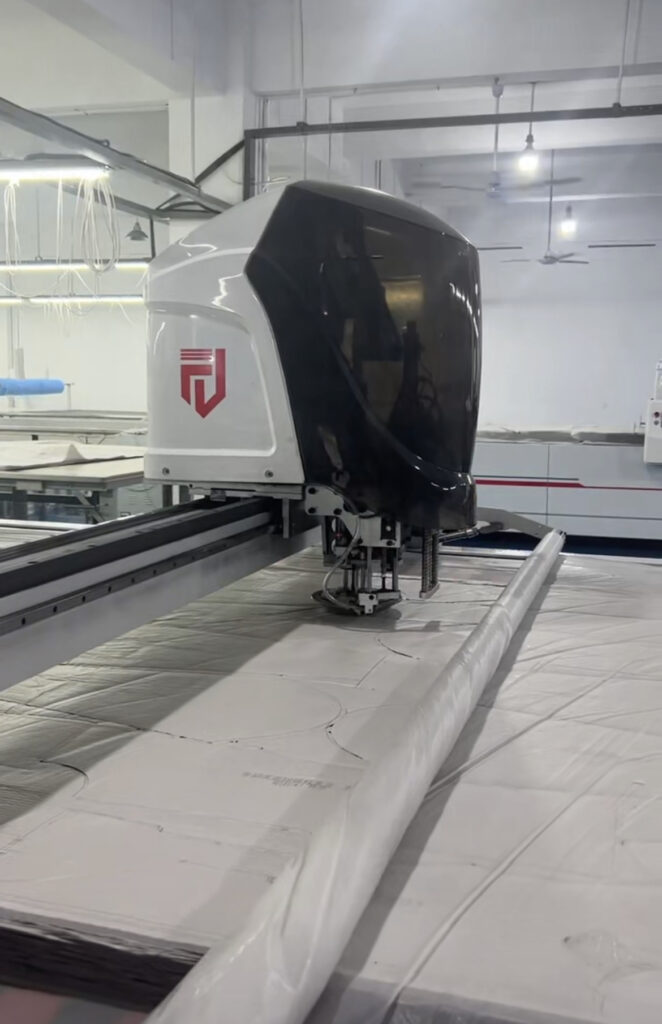
In recent years, with the rapid advancement of smart manufacturing, China’s garment industry has witnessed a significant shift toward automation. In the past, cutting processes relied heavily on manual labor, which not only resulted in low efficiency but also led to pattern inaccuracies due to human error, ultimately affecting the overall quality of finished garments. To cope with increasingly fierce market competition and rising consumer expectations, a growing number of garment factories have begun introducing fully automated equipment.
The video below showcases an intelligent fully automatic cutting machine, representing an important technological advancement in garment cutting. Such equipment is typically equipped with high-precision sensors, intelligent control systems, and optimized algorithms, enabling efficient cutting of multi-layered fabrics based on pre-set pattern data.
The advantages of machine-based cutting are clear. First, in terms of efficiency, fully automatic cutting machines can complete several times the workload of manual labor within the same time frame, significantly shortening production cycles. Second, in terms of quality control, machines ensure that every cut strictly follows digital patterns, eliminating deviations caused by human operation and thereby improving cutting accuracy. This precision directly affects the dimensional consistency of finished garments, helping factories meet strict size standards while reducing rework rates and fabric waste.
Overall, the adoption of intelligent fully automatic cutting machines not only enhances production efficiency in garment factories but also drives the entire industry toward greater standardization, digitalization, and intelligent manufacturing. For companies seeking to build a competitive advantage in quality and cost control, this has become an undeniable trend.