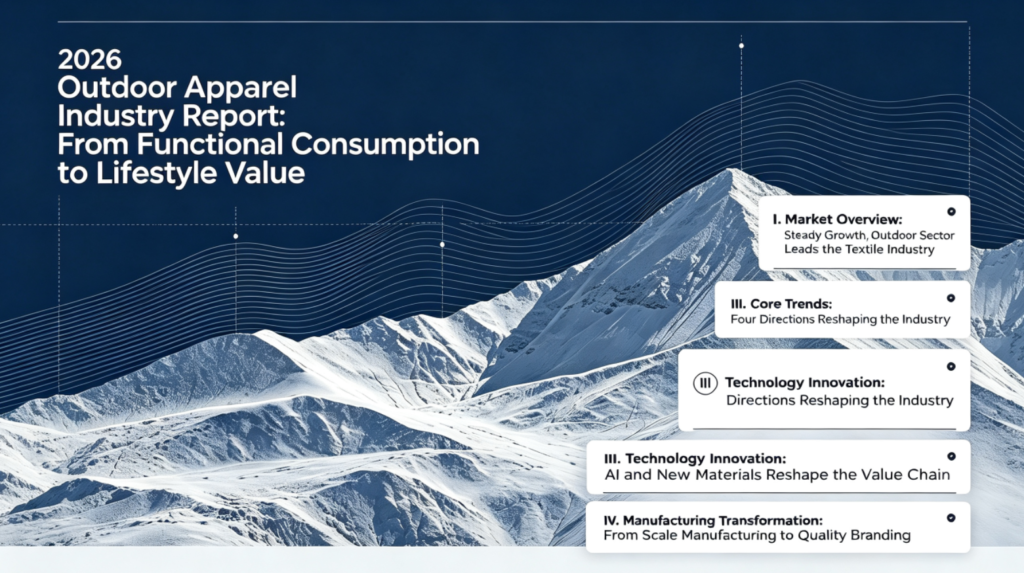
In 2026, the global outdoor apparel market continues its strong growth trajectory. Industry reports value the global outdoor apparel market at $183.2 billion, with a projected 6% CAGR reaching $292 billion by 2034. Alternative data sources place the 2025 market at $26.7 billion with a 7.9% CAGR toward $57.3 billion by 2035. While methodologies differ, the growth trend is unmistakable.
China’s market is particularly remarkable. The sportswear and footwear market reached RMB 598.6 billion in 2025, projected to hit RMB 896.3 billion by 2030. The camping economy alone topped RMB 248.3 billion, with RMB 488.5 billion forecast for 2030. With over 400 million outdoor participants, China’s high-performance outdoor apparel market now exceeds RMB 100 billion, entering a phase of refined, high-quality development.
Regional landscape: North America remains dominant—the U.S. accounts for 83% of the global market, valued at $9.6 billion in 2025. Europe is driven by sustainability regulations with strong demand for certified materials. Asia-Pacific emerges as a high-potential market fueled by rising middle-class and urban outdoor culture. Today, outdoor activity has evolved from “specialized sport” to a lifestyle for all.
The most significant trend in 2026: the boundaries of outdoor apparel use cases have completely dissolved. Consumers no longer purchase outdoor gear solely for mountaineering or trekking—they expect “one jacket, many uses”: a shell jacket that performs on the trail and fits into urban commuting.
This reflects a deeper shift in consumer logic: from “does the product work” to “does the product fit my lifestyle.” Outdoor demand has split into three distinct value segments:
Industry Implication: Brands must shift from “feature stacking” to “scenario fit.” Product design must balance technical performance with everyday aesthetics. Competition is no longer about professional barriers—it’s about the ability to make professional accessible.
In 2026, sustainability has moved from “nice-to-have” to “table stakes.” EU regulations (Strategy for Sustainable and Circular Textiles) tighten requirements on PFAS restrictions, product traceability, and environmental claims—these are now mandatory for export markets.
The industry is accelerating toward fluorine-free waterproofing. eVent Fabrics partnered with Beihai to bring PFAS-free alpineST and windstormST lamination technology to China. Goldwin is building a recycled nylon supply chain with Neste and Toray, replacing petrochemical raw materials with bio-based alternatives—first The North Face Japan products are expected by August 2026. At Link Fashion Shanghai 2026, Peak Performance showcased products using recycled nylon from ocean fishing nets paired with thermal disassembly technology for full lifecycle material circularity.
China is also taking action. The Outdoor Products Branch of China Textile Commerce Association is promoting group standards like the “Softshell Jacket Functional Classification and Evaluation Specification,” and a national standard for “Garment Rain Resistance Test Methods” is in development—standardization will drive manufacturing upgrades.
Industry Implication: Fluorine-free waterproofing, bio-based fabrics, and recycled materials are the technology focus. For manufacturers, environmental compliance is not optional—it’s mandatory. For brands, verifiable sustainability claims directly impact retail channel trust and consumer choice.
2026 shows clear consumption stratification. Lower-tier markets are booming: domestic brands like Camel leverage supply chain advantages to offer sun-protective jackets ranging from RMB 100 to nearly RMB 1,000, with offline stores selling over 100 units monthly. Consumer needs have shifted from single-function satisfaction to “outdoor performance + daily wear” integration. “Convenience” (54.5%) and “Comfort” (52.4%) are top purchase considerations, while “difficulty balancing multiple functions” (53.7%) and “overly rugged, single-purpose design” (48.4%) are the most cited pain points.
Simultaneously, the premium market continues to expand. Down jackets in the RMB 1,000–1,500 mid-high range and RMB 3,000+ luxury segment are growth engines, with technology upgrades (dynamic temperature control, zonal mixed filling) and design innovation supporting price increases.
Industry Implication: Brands need tiered product lines from entry-level to high-end, while capturing both “upgrading consumption” in lower-tier markets and “technology premium” in the luxury segment. “Convenience enhancement” (53.2%) and “AI integration” (49.9%) are cited by consumers as top optimization priorities.
The most prominent style trend in 2026: “Gorpcore” has broken through from professional outdoor to mass consumer culture. Take sun-protective jackets with mountain-inspired aesthetics: on Douyin e-commerce, related search interest grew over 22x during the “618” campaign, with sales doubling. These products use low-saturation earth tones and functional detailing—filling the gap of traditional sun-protective wear that prioritized function over aesthetics, perfectly matching young consumers’ desire for “practicality with ambiance.”
TMall’s “2026 Fall/Winter Sports & Outdoor Footwear & Apparel Trends White Paper” identifies six key seasonal trends: Relaxed Snow, Korean-Japanese Light Wilderness, Retro Active, Outdoor Nomad, Quiet Luxury, and Cold-zone Performance—covering everything from ski vacations to city commuting.
At the category level, we see a “soft vs. hard” polarization: hard-shell jackets dominate extreme outdoor scenarios with 3-layer lamination and fully sealed waterproofing; softshell jackets, in high-saturation colors and slim fits, penetrate the casual outdoor segment. Down jackets split into “lightweight zero-pressure” and “thick comfortable” parallel paths. Inner layers are growing with the popularization of the “3-layer system,” and fleece layering has the highest market maturity in this segment.
Industry Implication: The fusion of functional fabrics and lifestyle design is the core direction of product innovation. Brands should focus on the “light outdoor” consumer expansion opportunity, delivering professional function through more accessible design language to the mass market.
Artificial intelligence is becoming a critical productivity tool. AI now spans design, demand forecasting, manufacturing, and customer service:
Lightweighting and intelligent materials are the technology focus. Merino wool has broken seasonal limitations, with high-performance fabrics like Polartec and PERTEX driving premium pricing. Seamless knitting and seamless bonding eliminate traditional seam pain points, transitioning from differentiated advantage to industry standard.
Recycled nylon supply chains are maturing. Goldwin’s Japan collaboration provides a complete commercialization pathway from raw materials to finished garments—demonstrating that recycled and circular materials are the future direction of textile manufacturing.
For OEM/ODM manufacturers, 2026 represents a critical transformation window. The industry is moving from “scale manufacturing” to “quality manufacturing + branded operations.” Upstream manufacturers face three core challenges:
Partnering with Premium Clients: Performance divergence among major overseas brands is increasing. Outdoor and professional running brands show strong performance—manufacturers tied to quality clients will see structural order improvement. With tariff volatility, manufacturers with overseas capacity and mature global supply chains have stronger resilience.
Flexible Production & Collaborative Design: Brand demand for “small-batch customization” is rising. Manufacturers must transition from “manufacturing to specification” to “co-design,” invest in flexible production models, and build body-type databases suited to local markets.
Environmental Compliance Capability: PFAS-free materials, recycled fabrics, and BSCI/OEKO-TEX certifications are now entry barriers to international markets. Companies must build green, low-carbon sustainable ecosystems and align with international ESG standards.
2026 presents a clear picture: this is a pivotal year of transition from “functional consumption” to “lifestyle value.” The market is growing steadily, but the rules of competition have changed—no longer simply about technical specifications, but about the ability to translate professional value into consumer-experienced scenario value.
As industry forums consistently emphasize, the companies that will thrive in this high-quality development phase are those that can align product innovation with evolving consumer lifestyles—transforming functional expertise into accessible, desirable, and sustainable solutions for a growing global outdoor community.